 BetTennis
 Live Tennis Betting: Complete Guide to In-Play Tennis Wagering
 Available in US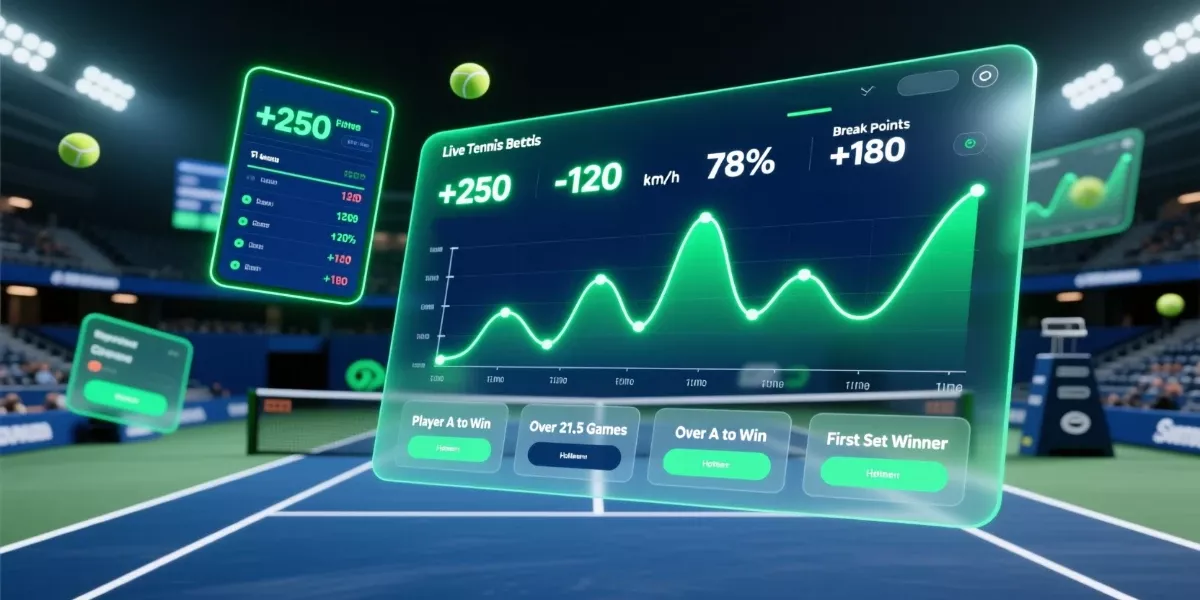
Real-time tennis betting interface showing dynamic odds movements and live match statistics
Live betting transforms tennis from a static pre-match analysis game into a dynamic, real-time strategic chess match. The odds update after every point. Momentum swings create massive value opportunities. A single service break can shift implied probabilities by twenty or thirty percentage points. For bettors who can read matches in real-time and react faster than the market adjusts, live betting is where the serious money gets made.
But here’s the catch: live betting is also where casual bettors get absolutely destroyed. The fast pace creates impulsive decisions. The emotional rollercoaster of watching close matches triggers tilt. The feed delay between what you see and what actually happened means you’re often betting on stale information. Most recreational bettors approach live betting like a slot machine, firing off bets based on gut reactions and getting crushed by variance and poor timing.
This guide breaks down how professional bettors actually approach live tennis wagering. We’re talking about systematic frameworks for reading momentum, understanding when odds overreact versus when they’re correctly adjusting, managing the feed delay problem, and maintaining discipline when adrenaline is screaming at you to bet everything on the next point. Live betting done correctly is the most profitable form of tennis wagering. Done incorrectly, it’s a fast track to emptying your bankroll.
Understanding Live Betting Odds Movement
Live odds in tennis move constantly, sometimes after every single point. Understanding why odds move and how quickly they adjust is fundamental to finding value. The sharper the market, the faster odds incorporate new information. Your edge comes from either having information the market doesn’t have yet, or correctly assessing that the market overreacted to variance rather than meaningful change.
Service breaks are the nuclear bombs of live odds movement. When an underdog at +250 breaks serve against a heavy favorite, their odds might immediately shorten to +120 or even money. The market recognizes that breaking serve in tennis is enormous, especially on faster surfaces where breaks are rare. But not all service breaks are created equal. Sometimes a break happens because of a few lucky net cords and the favorite making uncharacteristic errors. Other times it’s a clear sign the underdog has figured something out and gained genuine momentum.
Your job is distinguishing between variance and signal. If you’re watching the match and the service break looked fluky double fault on break point, a lucky net cord winner, a questionable line call the market probably overreacted. The favorite at now-improved odds is value. But if the underdog was dominating the return game, creating multiple break chances, and finally converted one, that break reflects genuine momentum shift. The market is correctly adjusting and there’s no value fading it.
Tiebreakers create massive odds swings because they’re high-variance and momentum-driven. A set that goes to a tiebreaker at 6-6 is effectively a coin flip, but the odds during the breaker fluctuate wildly. A player who gets to 4-1 in the breaker suddenly becomes a heavy favorite to win that set, which affects their match-winning odds significantly. If you can read tiebreaker momentum better than the algorithmic odds, this is pure profit.
First set results trigger major odds adjustments even though plenty of tennis remains. A favorite who wins the first set easily sees their odds shorten dramatically. Sometimes this is correct they’re dominating and the match is effectively over. But often, especially in best-of-three matches, the first set doesn’t predict the rest of the match. The losing player needed time to adjust, or they went down an early break and couldn’t recover that set, or a few points went against them. If you believe the match is closer than the first set result suggests, the odds after one set often provide excellent value.
Between-set odds stabilize briefly before the next set starts. This is when you should be making most of your live bets if possible. During play, the feed delay puts you at a disadvantage. Between sets, everyone has the same information and you have time to think rather than react impulsively. Use these windows to assess what just happened and what it means for the rest of the match.
Weather changes affect live odds less quickly than they should. If wind picks up significantly during a match, serve percentages will drop and break opportunities will increase. If you’re monitoring weather and notice the change before it fully impacts play, you can bet totals or service breaks at odds that haven’t adjusted yet. The market will eventually catch up but there’s a window where you have an edge.
Injury situations create the biggest information edges in live betting. A player starts moving poorly or grimacing after shots. They’re clearly compromised but still playing. The odds might not fully reflect the injury yet because casual bettors aren’t noticing the subtle signs. If you’re watching closely and see legitimate physical distress, you can bet against the injured player before the market fully prices in the problem.
Reading Match Momentum and Flow

Visual guide to identifying momentum shifts through player performance and body language
Momentum in tennis is real and measurable. It’s not just psychological it manifests in actual performance metrics like first serve percentage, unforced error rates, and break point conversion. Learning to read momentum shifts before the odds fully adjust is the core skill of profitable live betting.
String of games won or lost is the most obvious momentum indicator. A player who wins four straight games after being down a break has seized momentum. The psychological tide has turned. They’re confident, their opponent is tight, and the odds probably haven’t fully adjusted yet because the score might still look close overall. Betting momentum before it’s fully priced is how you extract value.
Service hold patterns tell you more than the score. If both players are holding serve easily, the match is likely decided by one or two breaks. If both players are struggling to hold serve, the match is a grind where anything can happen. If one player holds easily while the other barely survives service games, the player holding easily has a massive edge that might not be fully reflected in the odds yet.
Break point conversion rates during the match matter more than career statistics. A player might have a fifty percent career break point conversion rate but they’re converting eighty percent today because they’re seeing the ball well and their opponent is mentally fragile. Conversely, a strong converter who’s zero-for-four on break points today is struggling and might be worse value than their career numbers suggest.
Body language is the sneakiest edge in live betting. Racket smashing, arguing with coaching boxes, slouched shoulders, negative self-talk these are signs of mental distress that affect performance measurably. Algorithms pricing live odds don’t watch video feeds and spot body language. You can. When you see a player spiraling mentally, bet against them before the odds catch up. When you see a player who was frustrated suddenly relaxing and refocusing, bet on them.
Momentum shifts at specific score situations are predictable. Serving at 5-4 to win the set creates pressure. Some players thrive under pressure while others tighten up. If you know which players handle these situations well and which don’t, you can bet accordingly when they arise. Similarly, being broken while serving for the set is psychologically devastating for some players and energizing for their opponents.
Tactical adjustments happen during matches and create momentum shifts. A player who was staying on the baseline moves forward more aggressively. A player who was trying to overpower their opponent starts using more slice and variety. These mid-match adjustments take time to manifest in the score but they’re visible in the shot patterns. If you spot a successful tactical adjustment before it shows up in the scoreboard, you can bet the adjusting player at odds that don’t reflect their improved strategy yet.
Fatigue becomes a factor in longer matches, especially in best-of-five or on clay. Watch for reduced serve speed, shorter points, less movement on defense. When one player is visibly tiring and the other isn’t, the fit player has an edge that grows with each additional game. This is particularly exploitable in the third set of close matches where fitness determines the outcome more than skill.
Strategic Entry and Exit Points
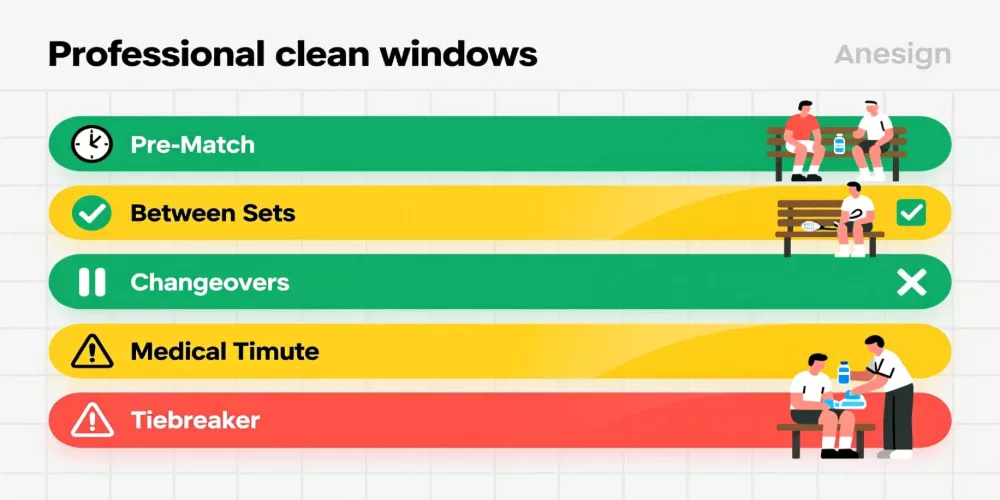
Timeline showing safe and optimal betting windows during live tennis matches
Knowing when to bet live is as important as knowing what to bet. The best live bettors are disciplined about only betting during specific situations where they have clear edges. They’re not betting every game or reacting to every point. They’re patient, waiting for their spots, then striking when the odds are demonstrably wrong.
Between sets is the safest and most strategic betting window. The feed delay doesn’t matter because nothing is happening. You have complete information about what just occurred. The odds have stabilized based on the set result. You can think clearly rather than reacting to real-time action. If you’re going to make live bets, most should come between sets when you have time and information advantage.
After momentum shifts that haven’t fully priced in. You watched three straight games where the underdog was dominating but hasn’t broken serve yet. The score still looks competitive but you can see the tide turning. This is when you bet the underdog before the inevitable break happens and odds collapse. You’re anticipating the market movement rather than reacting to it.
During medical timeouts and extended breaks. These pauses give you time to assess what’s happening without the pressure of in-play betting. If a player takes a medical timeout for an injury, you can evaluate whether it’s serious or just gamesmanship. If it seems serious, bet against them while the market is still uncertain. If it seems like gamesmanship, the market might overreact and create value on the player who took the timeout.
When weather conditions change mid-match. Wind picks up, rain stops and play resumes on damp courts, sun comes out after cloud cover. These environmental changes affect how the match plays but the odds lag behind the impact. If you’re monitoring conditions and understand how they affect the specific players competing, you can bet before the market adjusts.
Avoid betting during close tiebreakers unless you have strong conviction. Tiebreakers are high-variance and the odds swing wildly on every point. The feed delay means you’re always betting on stale information during breakers. Unless you’ve spotted something the market missed an injury, mental collapse, clear momentum stay out of tiebreaker betting. The variance is too high and your edge is too small.
Exit opportunities through cash-out features. Many sportsbooks offer cash-outs where you can settle your bet early at current market value. If you bet an underdog pre-match and they’re winning after one set, the book might offer a cash-out for guaranteed profit. Whether you take it depends on your conviction. If your thesis hasn’t changed and you still believe the underdog is undervalued, let it ride. If you think you got lucky and want to lock profit, cash out. There’s no universal right answer calculate expected value of each option.
Don’t bet every match you watch. The temptation with live betting is constant action. You’re watching, things are happening, you want to bet. Resist this. Most of the time, the odds are reasonably efficient and there’s no clear edge. Wait for situations where you genuinely have information or insight the market doesn’t. Selectivity is what makes live betting profitable. Volume without edge just increases variance and pays juice.
Managing the Feed Delay Problem
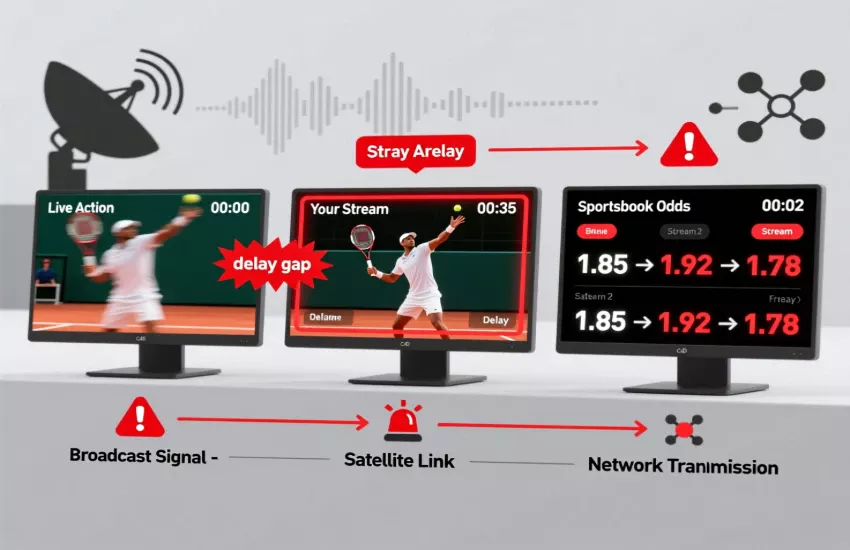
Technical diagram illustrating the feed delay challenge in live tennis betting
The feed delay is the biggest technical challenge in live tennis betting. Your television or streaming feed is typically twenty to forty seconds behind real-time action. Sportsbooks have near-instantaneous feeds. This means when you see something happen and try to bet it, the odds already moved. You’re betting on information everyone else already has. This kills your edge instantly.
The only solution is betting during stoppages. Between games, between sets, during medical timeouts, injury breaks, any pause in play. During these windows, the delay doesn’t matter because nothing is happening in real-time. Your information is as current as anyone else’s and you can make informed decisions without fighting the lag.
If you absolutely must bet during live play, bet only on outcomes that won’t be resolved in the next thirty seconds. Don’t bet on who wins the current point or the current game if it’s already 30-30. By the time your bet processes, that outcome might already be decided. Instead, bet on who wins the set or the match, outcomes that won’t resolve during your feed delay.
Accept that you’ll miss opportunities because of feed delay. You’ll see something happen that creates obvious value, try to bet it, and find the odds already moved. That’s the price of using consumer feeds instead of professional data feeds. Don’t tilt about it. Don’t try to chase the opportunity at now-worse odds. Just accept it and wait for the next clean opportunity.
Radio or audio feeds are sometimes faster than video. If you can find a radio broadcast of the match, audio commentary often runs closer to real-time than video streaming. The delay still exists but it’s smaller. This won’t eliminate the problem but it might reduce it enough to matter in close situations.
Betting during changeovers is a compromise. The ninety-second changeover between odd-numbered games gives you a window where nothing is happening competitively. You can quickly assess the last game, check statistics, and place a bet before play resumes. This isn’t as safe as between-set betting but it’s safer than betting during active points.
Some bettors use multiple feeds to triangulate timing. They watch the match on one screen and check live scores on another screen that might update faster. When the score updates, they know play has resumed even if their video feed hasn’t shown it yet. This is technical and annoying but it helps mitigate the delay problem slightly.
Live Betting Markets and Options
Live betting offers the same markets as pre-match plus some additional in-play-specific options. Understanding which markets offer the best value and when to use each one is crucial for profitable live wagering.
Match winner remains the primary market. Who wins the match outright. These odds update constantly throughout play but especially after set results and service breaks. This is where most volume flows, making it relatively efficient but also where most opportunities exist simply due to volume.
Set winner markets appear during each set. Who wins this specific set? These are independent from match winner odds and can offer value when you believe a player wins this set but still loses the match. A player might be down 0-1 in sets but you believe they’ll win the second set before ultimately losing. Betting them to win the second set at good odds is a way to extract value from a single set without committing to the full match outcome.
Game winner markets bet on individual games during play. Will the server hold this game? These appear and disappear quickly and have lower limits, but they offer high-frequency betting opportunities. If you’ve identified a player struggling to hold serve, you can bet against them game by game. The variance is high on any individual game but over multiple games, edge compounds.
Next point winner is ultra-granular. Some books offer odds on the literal next point. This is pure gambling unless you have information about an injury or mental state that makes one player heavily favored. The feed delay makes these bets nearly impossible to place with any edge. Avoid unless you’re purely gambling for entertainment.
Totals betting updates throughout matches. The total games or sets adjusts based on current score and projected match trajectory. If the first set went to a tiebreaker and you believe the match stays competitive, the updated over might have value if it dropped. If the first set was quick and lopsided, the under might have value if it hasn’t adjusted far enough.
Correct score betting on remaining sets. You can bet on the exact score of sets yet to be played. If you’re confident the favorite wins the next two sets easily, betting them to win 6-2, 6-3 or similar pays better than just betting them to win the match. This is high-variance but offers juicy odds when you have strong conviction.
Prop bets during play include markets like next player to win a game, who wins more games in the set, will there be a tiebreaker. These niche markets often have softer odds because less money flows through them. If you’re doing the analytical work, props in-play can offer excellent value.
Psychological Discipline in Live Betting

Essential discipline checklist for maintaining profitable live betting habits
Live betting is psychologically demanding in ways pre-match betting isn’t. You’re watching the match unfold. Emotions run high. The temptation for impulsive decisions is overwhelming. Most bettors lose at live betting not because their analysis is wrong but because they lack the discipline to stick to their process.
Tilt is the greatest enemy of live betting profit. You watch your player get broken serving for the set. It feels terrible. You immediately want to bet more to “get even” or you want to rage-bet against them because you’re frustrated. These emotional reactions destroy bankrolls. The antidote is having rules and following them regardless of emotion.
Set maximum bet sizes for live betting. Even if you normally bet two units on strong plays, limit live bets to one unit maximum. The faster pace and emotional involvement of watching makes it too easy to overbet. Capping your live bet size protects you from your own impulses during heated moments.
Take breaks after losses. If you lose two live bets in a row, step away from betting that match entirely. Close the app. Stop watching for ten minutes. Reset emotionally. The compound effect of consecutive losses while watching is devastating psychologically. Breaking the cycle prevents tilt.
Don’t bet every game or every set. You’re not required to have action constantly just because you’re watching. Most of the time, the odds are reasonable and there’s no clear edge. Accepting this and sitting on your hands is a skill. The best live bettors make far fewer bets than you’d expect because they’re highly selective.
Track your live betting results separately from pre-match results. You might be profitable pre-match but losing live, or vice versa. Without separating the data, you won’t know. If you discover you’re losing at live betting despite winning pre-match, the solution might be to stop live betting entirely rather than trying to fix it.
Create a checklist before every live bet. What’s my edge? Why do I believe the odds are wrong? Am I betting based on analysis or emotion? Would I make this same bet if I weren’t watching? These questions slow down decision-making and prevent impulsive betting.
Accept variance philosophically. You’ll place perfect live bets that lose. You’ll place questionable bets that win. Results in small samples don’t validate or invalidate your process. Stay focused on whether you’re making positive expected value decisions. If you are, results take care of themselves over large samples.
Advanced Live Betting Techniques
Professional live bettors use sophisticated techniques that casual bettors never consider. These aren’t secret strategies they’re just disciplined applications of probability theory and strategic thinking that most people don’t bother implementing.
Hedging pre-match bets through live betting. You bet an underdog pre-match at +250. They win the first set and their odds shorten to +120. Now you bet the favorite on the live line at reasonable odds, guaranteeing profit regardless of who wins. This isn’t trying to have it both ways it’s locking in profit when the market has moved in your favor.
Middling opportunities occur when you can bet both sides at prices that overlap profitably. You bet the favorite pre-match at -3.5 games. During the match, the live spread moves to +4.5 games on the underdog. You bet the underdog live. Now you win both bets if the favorite wins by exactly four games, and you win one bet regardless. This is rare but when it happens, it’s free money.
Scalping small edges repeatedly. Instead of making big bets on uncertain outcomes, some live bettors make numerous smaller bets on situations where they have tiny edges. Bet twenty times at 52 percent win probability in spots the market prices at 50 percent. Over volume, these small edges compound into steady profit. This requires discipline and bankroll to handle variance but it’s extremely effective.
Situational betting based on score patterns. Certain scores create predictable psychological pressure. Serving at 5-4 to win the set. Serving at 4-5 to stay in the set. Being broken serving for the match. These situations affect players differently based on personality and experience. Build a database of how specific players perform in these pressure situations, then bet accordingly when they arise.
Weather arbitrage by monitoring forecasts. You see that rain is likely in twenty minutes. The match is currently competitive but you believe the rain delay will benefit one player over the other maybe they’re older and the rest will help, or they’re mentally fragile and the interruption will hurt them. Bet before the rain hits and before the market prices in the delay.
Combining live betting with statistical models. Run a real-time probability model as the match progresses. When your model says Player A has a sixty percent chance to win but the live odds imply only fifty-five percent, you’ve found value. This requires technical sophistication but it’s how sharp bettors consistently beat live markets.
Surface-Specific Live Betting Considerations
Each surface creates different live betting dynamics. What works on clay might be terrible strategy on grass. Understanding surface-specific nuances helps you identify edges the general market misses.
Hard court matches vary by venue but generally fall between clay and grass in terms of service holds and match length. The live betting approach depends on court speed. Fast hard courts play more like grass breaks are important and rare. Slow hard courts play more like clay rallies extend and breaks are more common. Adjust your live betting strategy based on the specific hard court characteristics.
Indoor matches play faster and more predictably than outdoor matches. No wind, consistent temperature, reliable ball flight. This reduces variance and makes matches more predictable based on skill and form. Live betting indoors requires less weather consideration and more focus on pure matchup dynamics.
Transition periods between surfaces create opportunities. Players coming from clay to grass often struggle with the speed adjustment in early grass tournaments. If you’re watching and see a clay court specialist clearly struggling to adjust to grass, you can bet against them live before the odds fully reflect how poorly they’re playing. Similarly, moving from grass to hard courts creates timing adjustments that sharp bettors exploit.
Building a Sustainable Live Betting Strategy
Long-term profitability in live betting requires systematizing your approach. You can’t rely on gut feelings and still maintain edge over hundreds of matches. You need frameworks, rules, and discipline.
Specialize in specific situations rather than betting everything. Maybe you focus exclusively on first set results and how they affect second set odds. Maybe you specialize in matches between defensive baseliners where you can read fatigue better than the market. Maybe you only bet tiebreakers at Grand Slams where you’ve studied player performance under pressure extensively. Specialization lets you develop genuine expertise rather than being mediocre at everything.
Build databases of player-specific tendencies. How does Player A perform after losing the first set? What’s Player B’s record in tiebreakers at majors? How often does Player C convert break points in the third set of close matches? This granular data reveals patterns the market doesn’t price accurately. Compile it systematically and reference it during live matches.
The ultimate goal is sustainable profit, not maximum action. You’re not trying to bet every match you watch. You’re trying to identify the specific situations where you have clear edges and bet only those spots. Everything else is noise. The bettors making real money from live betting are boring and disciplined. They make fewer bets than you’d think, wait patiently for their spots, and execute ruthlessly when edges appear. That’s the model to follow.
See also: bet-tennis – your home for tennis betting.
See also: Grand Slam Betting Guide – live betting during Grand Slam matches.
