 BetTennis
 Tennis Betting Markets Explained: Moneyline, Spreads, Totals & More
 Available in US
Tennis betting markets offer more variety than most bettors realize. Walk into any serious discussion about tennis wagering and you’ll hear people throwing around terms like “game spreads,” “set betting,” and “alternate totals” like everyone understands exactly what they mean. But here’s the reality: most recreational bettors stick to moneyline bets because everything else seems complicated or risky. They’re leaving money on the table.
Understanding the full range of tennis betting markets isn’t about becoming some degenerate gambler who bets everything in sight. It’s about having the right tool for the right situation. Sometimes the moneyline is the play. Sometimes it’s overpriced and the spread offers better value. Sometimes the match outcome is too uncertain but you have strong conviction about the match going long or short. Each market exists for a reason, and knowing when to use which one is what separates bettors who grind out profits from those who wonder why they keep losing.
This guide breaks down every major tennis betting market, explains how each one actually works beyond the surface-level basics everyone already knows, and shows you the strategic thinking that helps you identify when specific markets offer value. We’re not going to waste time with generic advice like “research before betting.” You already know that. Instead, we’re diving into the mechanics, the math, and the market inefficiencies that create opportunities.
Moneyline Betting Deep Dive
Moneyline betting is the foundation of tennis wagering. Pick who wins the match. That’s it. No spreads to cover, no totals to worry about, just pure prediction of the winner. It’s clean and straightforward, which is why probably seventy-five percent of all tennis betting money flows through moneyline markets.
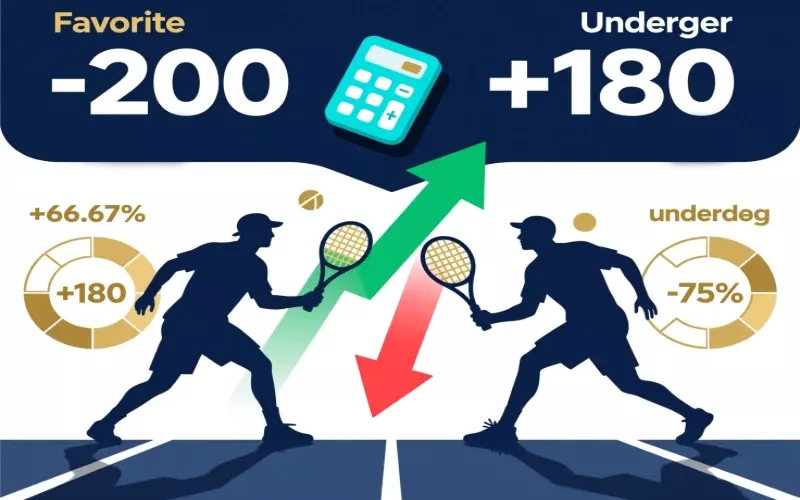
The basics are simple enough. Negative odds represent the favorite. Positive odds represent the underdog. A player at -200 requires risking two hundred dollars to profit one hundred. A player at +180 means a hundred dollar bet profits one eighty. This isn’t complicated math. But here’s where most bettors stop thinking, and that’s a mistake.
Favorites in tennis win more often than favorites in most other sports. Some estimates put it above seventy-five percent. This happens because tennis is an individual sport with minimal randomness compared to team sports. The better player usually wins. There’s no teammate to mess up. No fluky fumble. No questionable referee call that changes everything. Just two people with rackets, and usually the more skilled one prevails.
This creates a psychological trap. Bettors see favorites winning constantly and think backing favorites is the path to profit. But sportsbooks aren’t stupid. They price favorites accordingly. When you’re laying -300 or -400 on a favorite, you’re not getting value even if they win eighty percent of the time. The math doesn’t work. You need that favorite to win four straight matches just to break even after one loss. String together a few favorites and one upset wipes out your profits.
The break-even calculation matters more than most bettors realize. At -200, you need to win exactly 66.67 percent of your bets to break even long-term. At -300, you need 75 percent. At -150, you need 60 percent. If you’re betting favorites at -200 but your actual win rate over a large sample is only sixty-two percent, you’re losing money despite winning more bets than you lose. The juice is killing you slowly.
This is why sharp bettors often focus on finding underpriced favorites or overpriced underdogs rather than just backing the player they think will win. If your analysis suggests a player should be -250 but they’re priced at -180, that’s value on the favorite. If your analysis suggests a player should be +150 but they’re priced at +220, that’s value on the underdog. It’s not about picking winners. It’s about finding gaps between your assessed probability and the implied probability from the odds.
Timing matters significantly with moneyline betting. Odds when lines first post can differ dramatically from odds at match time. Early odds reflect the bookmaker’s initial assessment. As money comes in and information surfaces, odds adjust. A player might open at -180, drift to -160 if sharp money sees value on the opponent, or move to -200 if the public piles on. Understanding why lines move helps you determine whether the current price reflects smart money or dumb money.
Public betting creates predictable patterns. Popular players get overbet regardless of the actual matchup. When Alcaraz or Swiatek plays, recreational bettors flood the moneyline on the star player. This pushes odds higher on the favorite and creates value on the opponent. If you’re constantly betting against public sentiment on marquee players, you’re often getting better prices than the matchup warrants.
The ranking trap destroys more bankrolls than almost anything else in tennis betting. A player ranked fifteenth facing a player ranked fortieth gets priced as a solid favorite automatically. But rankings lag reality by months. They don’t account for surface specialization. They don’t reflect recent form or injury status. Betting blindly on the higher-ranked player is lazy analysis masquerading as informed betting.
Consider this scenario: Player A is ranked twenty-third but has won four straight matches on clay, their best surface. Player B is ranked twelfth but struggles on clay and just came off a three-week break with no match rhythm. The moneyline might still favor Player B based on ranking, but the actual matchup favors Player A. That’s where value exists.
Moneyline betting also requires understanding the concept of closing line value. If you bet a player at +160 and the match starts with that player at +140, you captured twenty cents of CLV. Even if the bet loses, getting better odds than the closing line suggests you’re identifying value before the market fully adjusts. Over hundreds of bets, consistently beating the closing line correlates strongly with long-term profitability. Track your CLV religiously if you’re serious about moneyline betting.
Spread Betting in Tennis
Spread betting levels the playing field by handicapping the favorite or giving the underdog a head start. Unlike football or basketball where spreads measure points scored, tennis spreads measure games won throughout the entire match. This creates different dynamics and strategic opportunities.
A game spread of -4.5 means the favorite must win five or more games than their opponent. If the favorite wins 6-3, 6-2, they won eighteen games total while the opponent won five games, giving them a thirteen-game margin. That crushes -4.5. But if the match goes 6-4, 4-6, 6-4, the favorite won sixteen games to fourteen, only a two-game margin. The favorite won the match but failed to cover the spread.
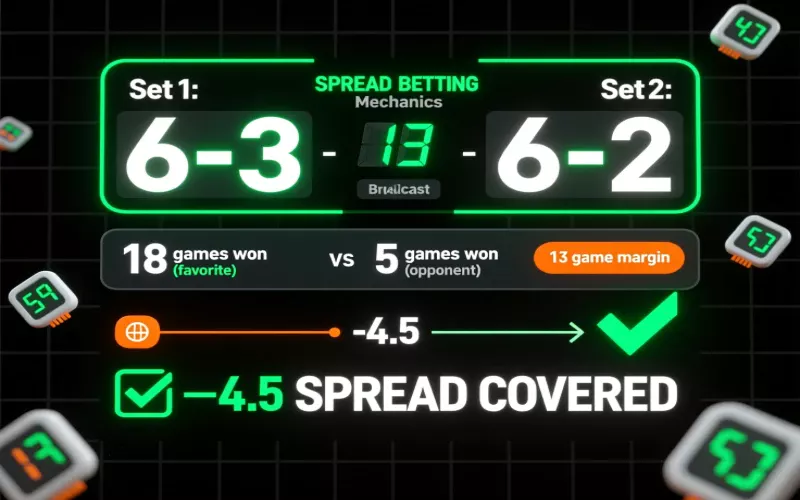
This distinction between winning the match and covering the spread creates interesting situations. You can correctly predict the match winner but lose your spread bet. Conversely, you can bet the underdog on the spread and win even when they lose the match, as long as they keep it close enough to cover their head start.
Set spreads work differently and are particularly interesting in Grand Slam tournaments where men play best-of-five. A -1.5 set spread means the favorite needs to win by at least two sets. In a best-of-five, winning 3-1 covers -1.5. Winning 3-2 doesn’t. In a best-of-three, the favorite must win in straight sets to cover -1.5.
The strategic angle with spreads involves finding situations where the moneyline odds are too steep but you still believe in the favorite’s dominance. Say Djokovic is -600 on the moneyline but -3.5 games at -120. If your analysis says he demolishes his opponent, the spread offers significantly better value than laying -600. You’re getting paid more for what should be the same outcome.
Playing style matchups heavily influence spread betting. A big server on grass facing a weak returner creates a spread-covering situation. Service holds dominate, the favorite breaks serve a few times, and the margin compounds. The match might not be competitive despite close set scores because the underdog never really threatens. These matches kill over-bettors who see close sets and assume competitiveness.
Conversely, two defensive baseliners grinding out long rallies creates tight matches even when one player is clearly better. The favorite might win but the games stay close because both players hold serve frequently and breaks are hard-fought. These matches are dangerous for spread betting on favorites.
Surface matters enormously for spread betting. Clay courts slow play and favor defense, making spreads harder to cover because matches stay competitive longer. Grass courts speed play and favor servers, creating more blowouts where spreads get covered easily. Hard courts sit in the middle but venue-specific characteristics matter. Some hard courts play fast, others slow. Know the venue.
Alternate spreads expand your options significantly. Instead of the main line at -4.5 games, you might find -2.5 at much worse odds or -6.5 at plus money. If you’re absolutely certain the favorite dominates, taking -6.5 at +150 offers better risk-reward than laying -4.5 at -110. If you think the favorite wins but it’s competitive, buying down to -2.5 even at -180 gives you insurance against a tight match.
Underdogs and spreads create different strategic considerations. A +5.5 game underdog just needs to keep it respectable. They can lose the match badly and still cover if they steal enough games. This matters when you think an underdog has the tools to hang around even if they ultimately lose. Maybe they serve well enough to hold most of their games but struggle to break serve. That profile covers spreads but loses matches.
Set spread betting requires evaluating how matches unfold, not just who wins. A player might drop the first set while adjusting, then dominate the next two sets. That’s a 2-1 victory that doesn’t cover -1.5 in best-of-three. But if they never drop a set, -1.5 cashes comfortably. You’re betting on dominance, not just victory.
Best-of-five versus best-of-three creates different spread dynamics. Best-of-five allows more time for quality to assert itself. A favorite can drop a set and still cover set spreads. Best-of-three is less forgiving. One bad set and the spread is toast even if the favorite recovers to win.
Totals Betting Strategy
Totals betting asks how long the match lasts in terms of games played. Sportsbooks set a number, usually something like 21.5 or 23.5 games for best-of-three matches, and you bet whether the actual total goes over or under. It’s less about who wins and more about the texture of the match.
Playing style compatibility drives totals more than almost anything. Two big servers with weak returns create service-hold fests where sets go to tiebreakers and games pile up. A match between John Isner and another big server can easily hit thirty-five or forty games because neither player can break serve. That’s automatic over territory.
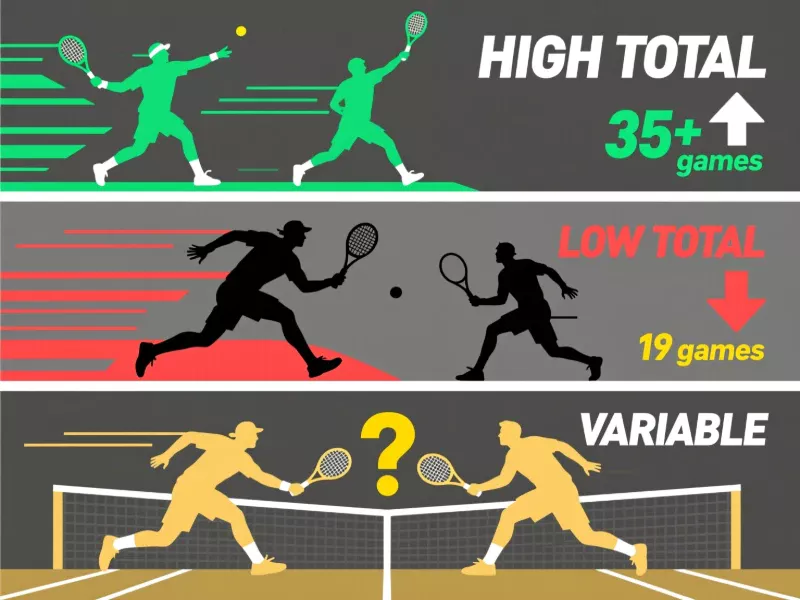
Compare that to a dominant player facing an overmatched opponent. The favorite holds serve easily at love or fifteen. The underdog gets broken repeatedly. Sets end 6-1, 6-2, maybe nineteen or twenty total games. That’s clear under territory.
The middle ground is two baseline grinders who trade breaks frequently. These matches are harder to predict because competitiveness could go either way. They might have long games with multiple deuces, pushing the total up. Or they might have efficient service holds and the total stays moderate. This is where form analysis and recent match durations become critical.
Surface impacts totals in predictable ways. Clay courts slow the ball, extend rallies, and favor returners. Matches on clay see more breaks of serve, longer games, and higher totals. Grass courts speed everything up, favor big servers, and produce lower totals. Hard courts vary by venue but generally sit between clay and grass.
Totals betting offers an interesting advantage: it’s less efficient than moneyline markets. Sportsbooks focus their sharpest people on getting match winner odds correct because that’s where volume concentrates. Totals get less attention and less sharp money, creating more mispriced lines. If you’ve done your homework on match duration and the total seems off, there’s probably value.
One trap with totals is assuming competitive matches automatically mean overs. A match can be intensely competitive with every game going to deuce while still finishing in straight sets at twenty-four games if neither player breaks serve until tiebreakers. Conversely, a blowout can hit the over if both players struggle to hold serve. Competitiveness and game count don’t correlate perfectly.
Correlated parlay restrictions matter for totals. You can’t parlay a favorite on the moneyline with the under because these outcomes are correlated. If the favorite dominates quickly, both hit. Sportsbooks block these combinations because they’re not independent events. Understanding correlations helps you think about totals strategically.
Futures and Outright Betting
Futures betting picks a tournament winner before it starts or during early rounds. The odds are long because you’re picking one player against the entire field, but the payouts are substantial for successful bets.
Grand Slam futures are the biggest markets. Australian Open, French Open, Wimbledon, and US Open attract massive betting interest. A favorite like Djokovic might open around -120 or +150 to win, meaning he’s close to even money against everyone else. That’s rare. Usually even the favorite sits at +200 to +400. Mid-tier players might be +1500 to +3000. Long shots can be +8000 or higher.
Hedging opportunities emerge naturally with futures. Say you bet a player at +600 before the tournament. They reach the final. Now you can bet their opponent on the moneyline, guaranteeing profit regardless of outcome. Structure the hedge correctly and you lock in meaningful profit either way. This is why having bankroll in reserve for hedging matters if you play futures seriously.
Early elimination risk is the obvious downside of futures betting. Your player can lose in Round 1 to a qualifier and your ticket is worthless. You’re betting they’ll win five, six, or seven matches in a row depending on the tournament. That’s a tall order even for favorites. Variance catches everyone eventually.
Multiple small futures bets spread across several players can be smarter than one large bet on a favorite. Put one unit each on five different players at +600, +800, +1200, +1500, and +2000. If any hit, you profit handsomely. If none hit, you lose five units but you had five chances instead of one. This portfolio approach reduces variance.
Prop Betting and Alternative Markets
Prop bets wager on specific events within a match rather than the overall winner. These markets have exploded recently as sportsbooks compete for action and try to keep bettors engaged throughout matches.
First set winner is the most common and straightforward prop. It’s exactly what it sounds like: who wins the first set. Some players are notoriously slow starters. Djokovic has dropped countless first sets before rallying to win matches. If you identify a player who consistently starts strong, first set winner offers value even if the match outcome is uncertain.
First set winner also works strategically for live betting. If you think a match will be competitive overall but one player edges the first set, you can bet that outcome and then reassess for the full match based on what happens. It’s a way to get action early without committing to the full match outcome.
Correct score betting wagers on the exact set score: 2-0, 2-1, etc. The odds are much higher because you’re pinpointing the exact outcome rather than just picking a winner. If you’re confident a favorite cruises in straight sets, betting them 2-0 pays significantly better than the straight moneyline. But if they drop a set, you lose even though you were right about the winner. It’s high variance, high reward.
Player performance props focus on individual statistics rather than match results. Total aces served is a common one. A big server on grass might have an aces line set at 12.5. If they’ve been averaging fifteen aces per match on grass and conditions favor serving, the over screams value. These props require diving into statistics but they’re often softer than main markets.
Total double faults works similarly. Inconsistent servers have higher double fault totals, especially under pressure. If you’ve identified a player who sprays serves when tight and they’re facing a strong returner who creates pressure, the over on double faults makes sense.
Prop betting requires deep statistical knowledge. You’re not just evaluating who wins but specific aspects of how the match unfolds. The good news is most recreational bettors ignore props entirely, focusing on moneylines and spreads. This means prop markets can be softer with less sharp money, creating opportunities for bettors willing to dig into the data.
The downside is lower limits. Sportsbooks don’t take massive prop bets because the markets are smaller and more vulnerable to informed betting. If you find edges in props, you’ll win but you won’t get rich because you can’t bet enough to move the needle dramatically on your bankroll.
Live Betting Markets
Live betting transforms tennis from a pre-match analysis exercise into a dynamic, real-time strategy game. The odds update constantly during play, responding to every point, every game, and every momentum shift. This creates opportunities unavailable in pre-match markets.
Every betting market available pre-match typically exists in-play as well. Moneyline odds shift after every point. Set winners adjust as sets progress. Totals recalculate based on current game count and projected match trajectory. Game winners and next point winners flash on and off the board in real-time.
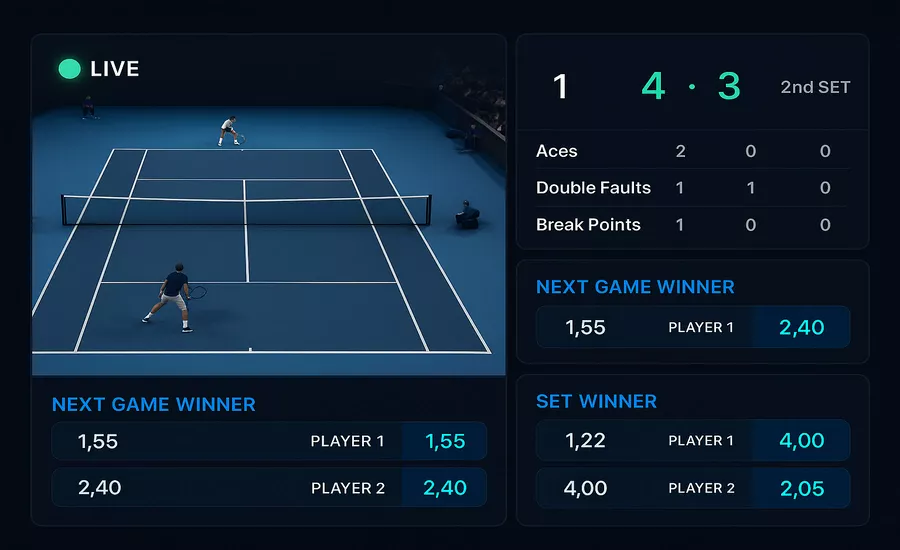
Service breaks move odds dramatically. When an underdog breaks serve against a heavy favorite, their match-winning odds shorten immediately. The market recognizes that breaking serve in tennis is huge, especially on faster surfaces. But sometimes the break happens due to a few lucky bounces or one bad service game from the favorite. If you’re watching and you saw it was fluky, the favorite is now value at improved odds.
Conversely, when a favorite breaks back after dropping serve, the odds often overshoot. The market assumes the favorite is reasserting dominance. But maybe the underdog just had a bad service game and is still playing well otherwise. The underdog’s odds lengthen more than warranted, creating value.
Momentum reading separates winning live bettors from losing ones. A player wins three straight games after being down a break. The tide is turning. Their confidence is building while their opponent is tightening. The odds might not fully reflect this momentum shift yet. That’s your window.
Between-set betting is cleaner than in-game betting. After a set completes, odds stabilize briefly. You have time to assess what just happened and what it means for the rest of the match. Did the losing player adjust their tactics? Did the winning player peak or do they have more in the tank? These between-set windows are prime opportunities for strategic live betting without fighting the feed delay.
Next game winner markets offer high-frequency action. Every service game is a betting opportunity. If you’ve identified a player struggling to hold serve or a returner dominating, you can bet game by game. The variance is high any individual game is nearly a coin flip but if you’ve spotted an edge, you can exploit it repeatedly within the same match.
Parlay and Accumulator Betting
Parlays combine multiple bets into one ticket with multiplied odds. Win all legs and your payout is substantially higher than betting each individually. Lose any leg and the entire ticket loses. Sportsbooks love parlays because they’re mathematically advantageous to the house even when bettors win individual legs at expected rates.
Standard parlays in tennis might combine several moneyline favorites from different matches. Player A at -180, Player B at -200, Player C at -150. Independently these aren’t exciting. Combined into a three-leg parlay, you’re getting something like +220 or +250. The allure is obvious: risk one unit to win two-plus units on favorites you expect to win anyway.
The problem is the math. Even if each individual favorite has a seventy percent chance of winning, the parlay of all three has only about a thirty-four percent chance of hitting. The odds offered don’t fully compensate for the decreased probability. Over many parlays, you’re giving the house more edge than betting singles.
That said, parlays aren’t automatically bad. Strategic two-leg parlays pairing strong convictions can be reasonable. If you love two favorites but the moneyline odds are too steep to bet individually, combining them into a parlay gets you to reasonable odds. Just understand you’re increasing variance and giving up some edge.
Round-robin parlays create multiple parlay combinations from a selection of bets. Instead of one three-leg parlay, you create three two-leg parlays from three selections. If two of three legs win, you still profit from the successful two-leg parlay. It’s a way to get parlay upside while protecting against one bad leg sinking everything.
Professional bettors rarely use parlays except strategically. They’d rather make three separate one-unit bets and win two of three, collecting profit on both wins, than make one parlay that loses everything if one leg fails. The exception is when correlated outcomes offer value that a sportsbook hasn’t fully priced, but these opportunities are rare.
If you’re going to parlay, limit it to two or three legs maximum. Keep the individual legs to bets you’d make anyway as singles. Never include a weak leg just to boost odds. And never bet more on a parlay than you’d bet on a single. Parlays are spice, not the main dish of a betting diet.
Understanding Market Efficiency Across Different Bet Types
Not all tennis betting markets are equally efficient. Efficiency means how well the odds reflect true probability. Sharp, efficient markets have odds that closely match actual likelihoods because informed money and sophisticated algorithms have beaten the lines into accurate prices. Soft, inefficient markets have mispriced odds because less attention and money flow there.
Moneyline markets for Grand Slams and Masters 1000 events are very efficient. Massive betting volume, sharp bettors, and sportsbook focus all combine to create odds that are difficult to beat. You can still find value through superior analysis, but the margins are thin and the work is harder.
Moneyline markets for ATP 250 events, Challenger tours, and early rounds of smaller tournaments are softer. Less money flows through these matches. Sportsbooks use algorithms without deep human insights. If you follow lower-level tennis closely, you’ll know things the market doesn’t, creating sustainable edges.
Spread markets are generally less efficient than moneylines because less betting volume flows through them. Sportsbooks focus their best odds-making on moneylines. Spreads get less attention. If you’ve done deep analysis on how a match will unfold stylistically, you’ll often find better value in spreads than moneylines.
Futures markets start soft and get efficient as tournaments progress. Early futures odds reflect broad probabilities without detailed matchup analysis. As the tournament unfolds and the field narrows, odds sharpen dramatically. The best futures value often exists in pre-tournament betting on medium-priced players where you have information edge the market hasn’t incorporated.
Choosing the Right Market for Each Situation
The biggest mistake bettors make isn’t picking the wrong player. It’s picking the right player in the wrong market. You might correctly identify that Player A beats Player B, but if you bet the moneyline at -400 when the spread at -3.5 offered much better value for the same outcome, you cost yourself profit.
When the favorite is heavily favored but you expect dominance, consider spreads over moneyline. Laying -500 on the moneyline is tough to stomach. Taking -4.5 games at -120 gets you similar exposure with better odds if your dominance thesis is correct.
The sophisticated approach is analyzing each match and determining which market offers the clearest edge. Sometimes it’s the moneyline. Sometimes it’s a prop. Sometimes it’s nothing and you skip the match entirely. Flexibility and market selection are skills that develop with experience.
See also: bet-tennis – explore all tennis betting guides.
See also: Live Tennis Betting Guide – find the best markets for live betting.
